The back story
Two kinds of royalty: the Prince of Wales at Dharma, and the Nawab of Pataudi
Karan Johar, Kareena and Saif host the Prince of Wales at Dharma, and the Nawab’s two royal lines.
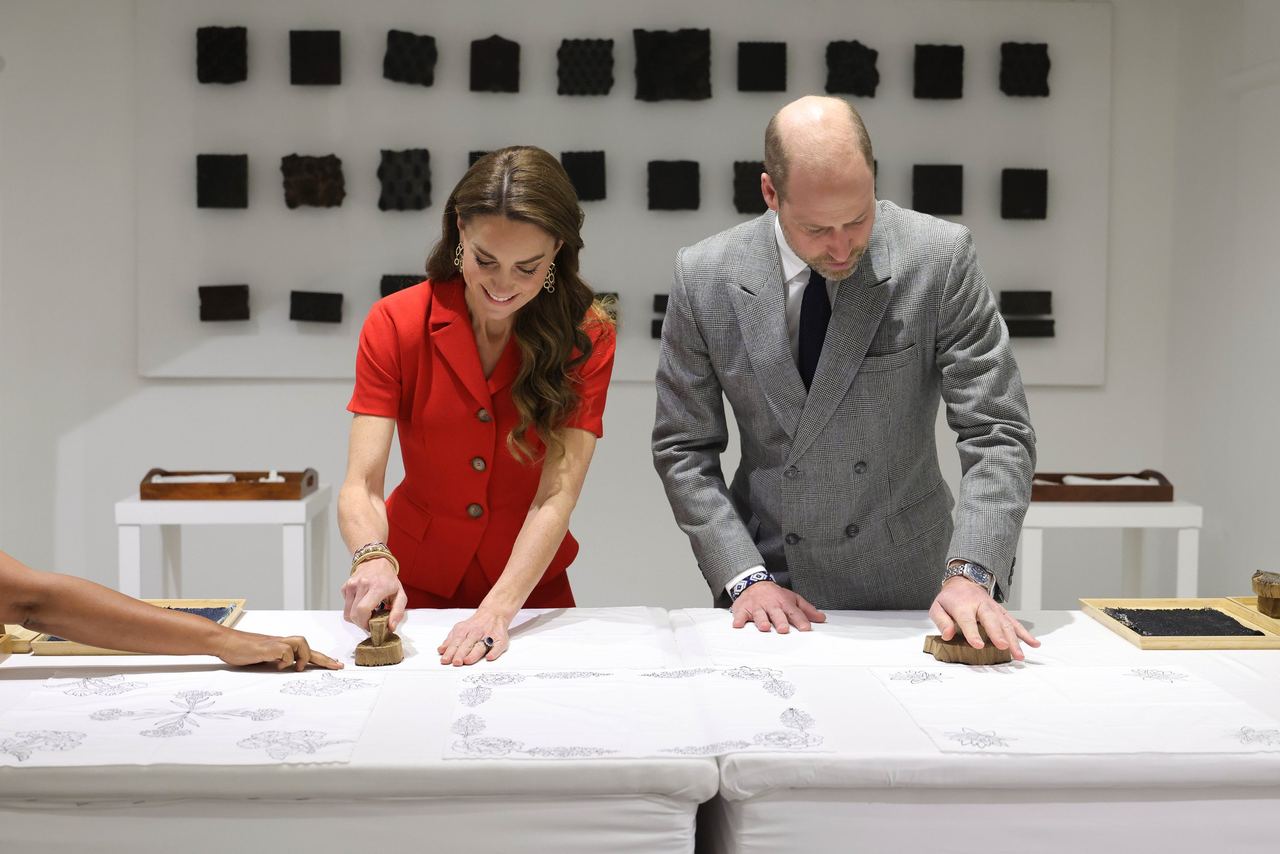
Photo Credit
Image courtesy of © Andrew Parsons / Kensington Palace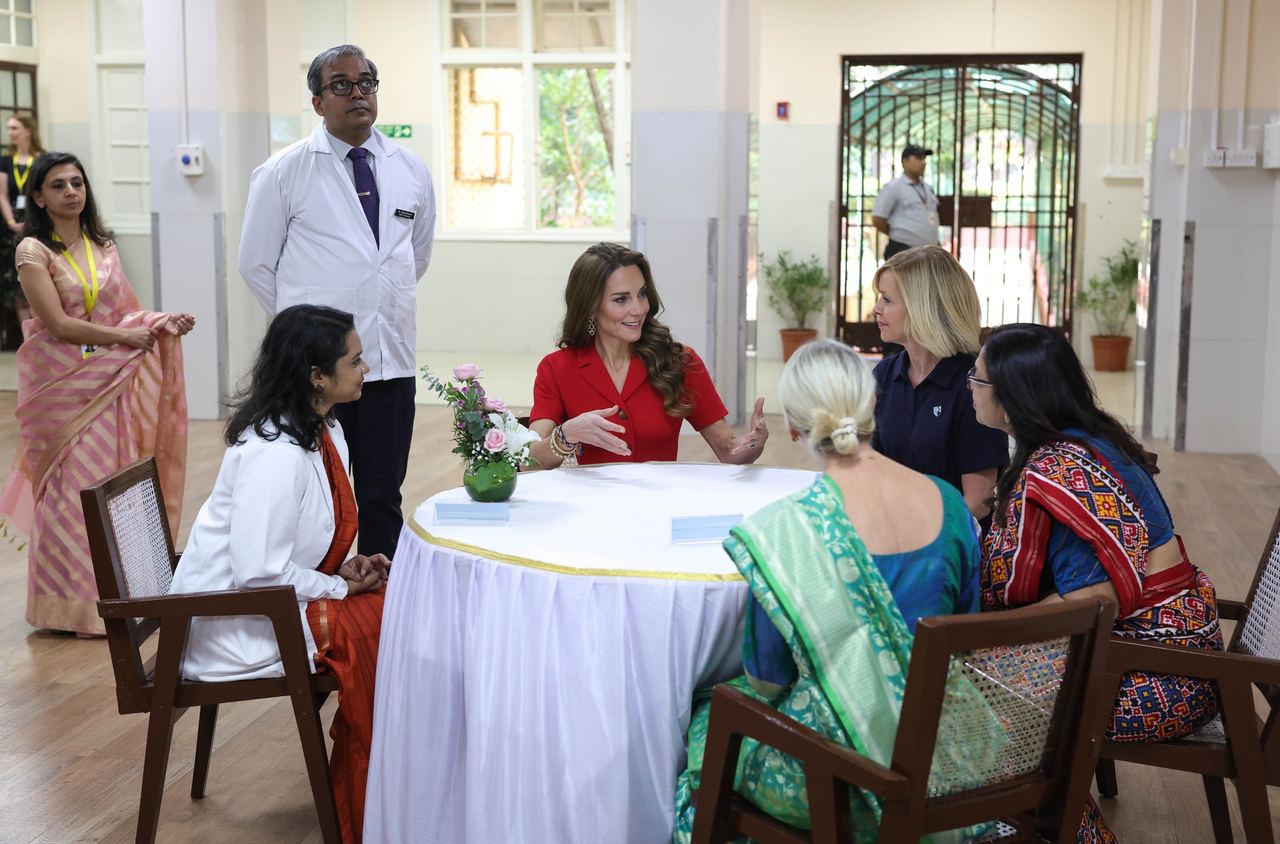
Photo Credit
Image courtesy of © Andrew Parsons / Kensington Palace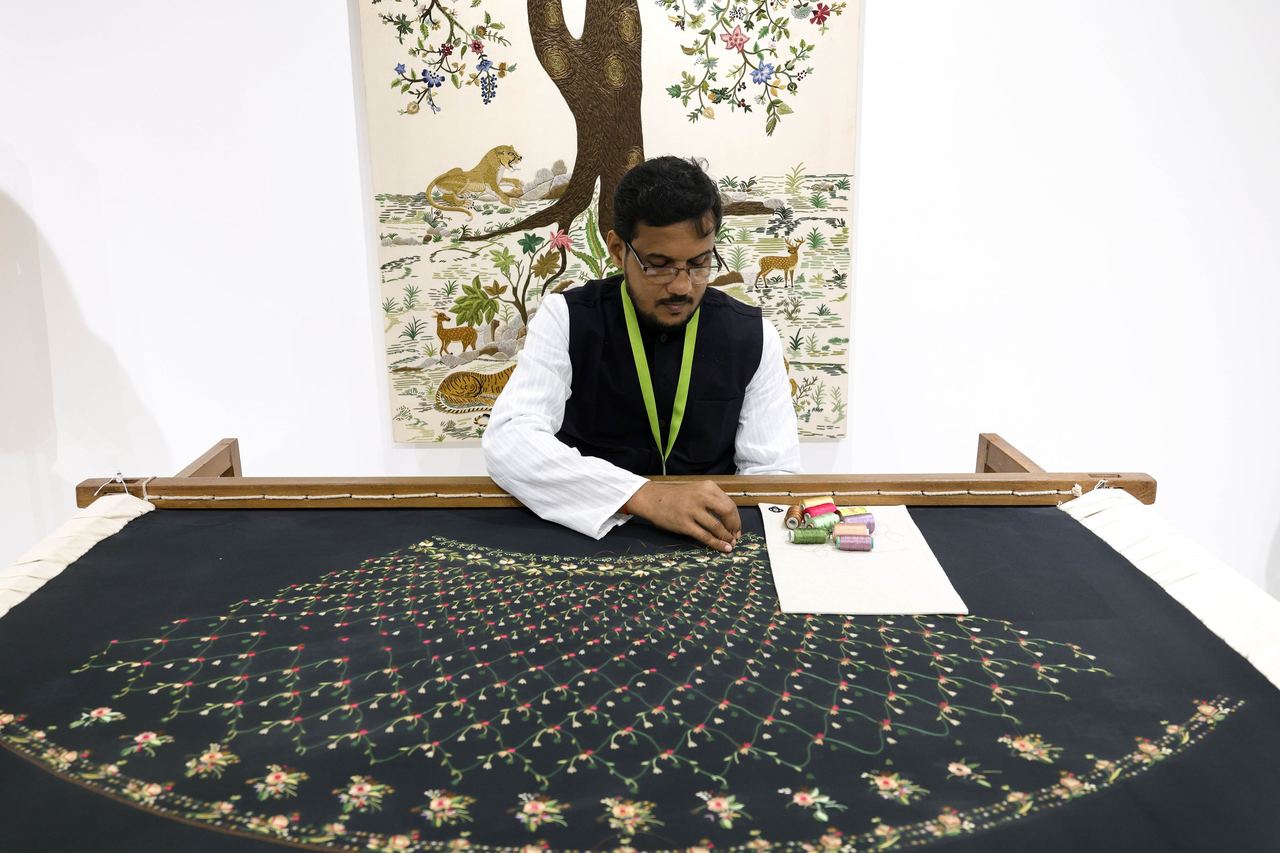
Photo Credit
Image courtesy of © Andrew Parsons / Kensington Palace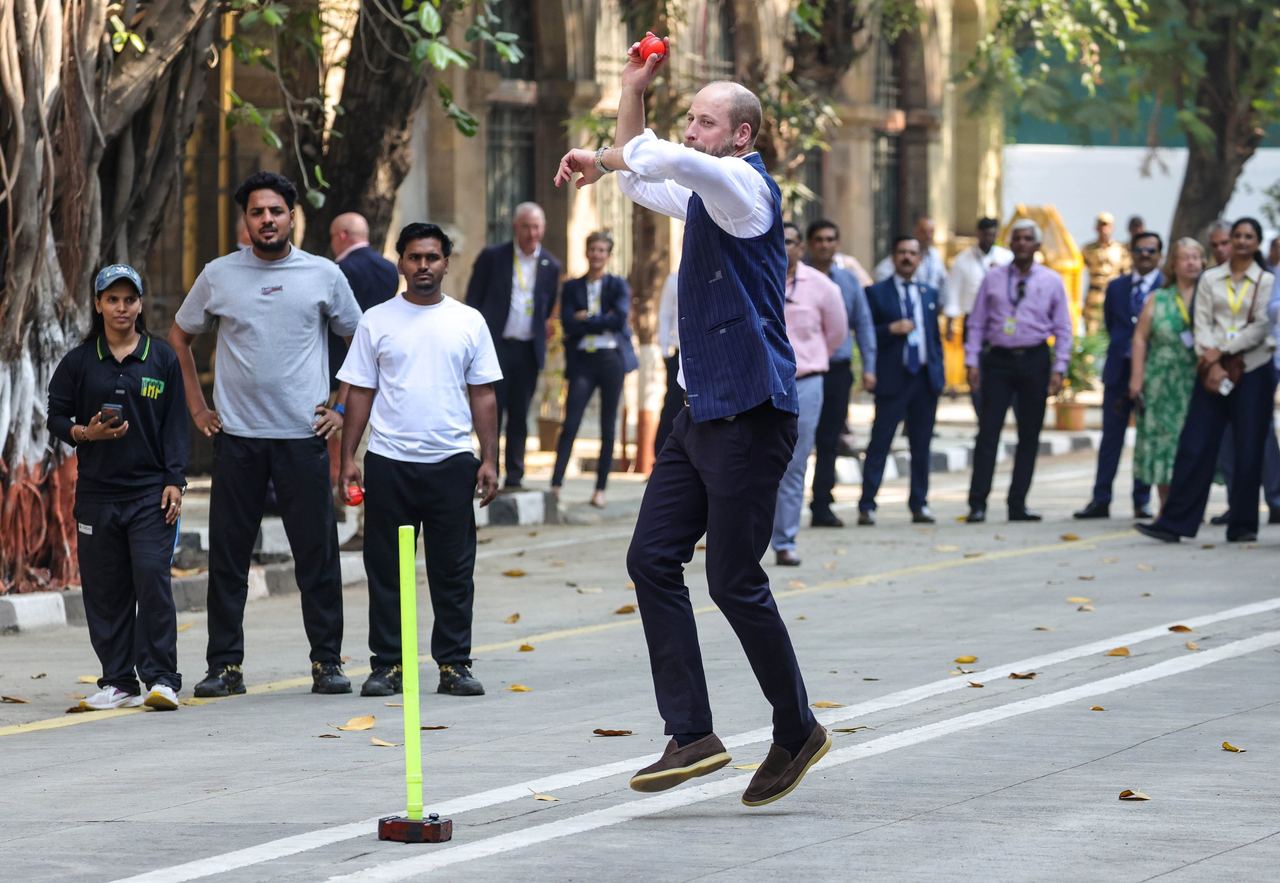
Photo Credit
Image courtesy of © Andrew Parsons / Kensington Palace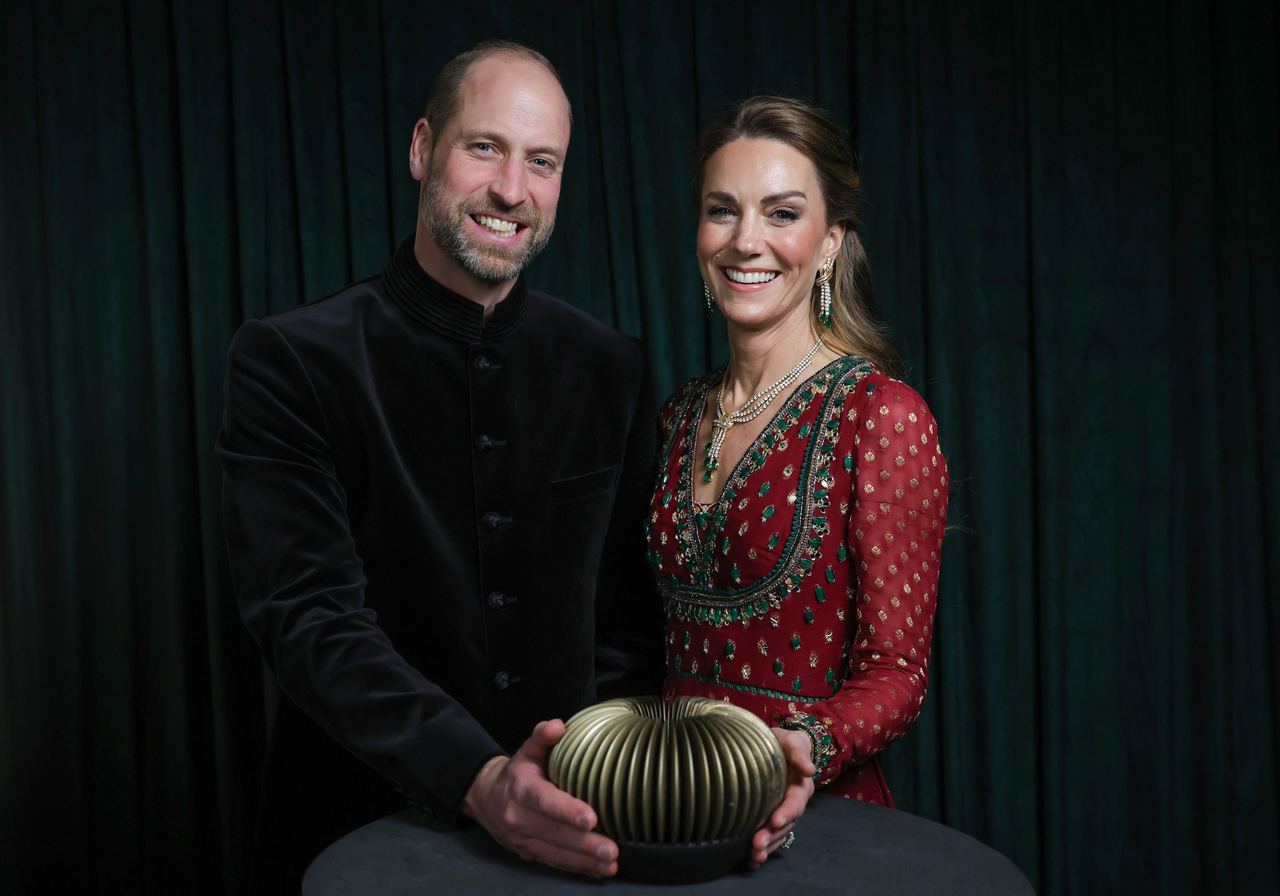
Photo Credit
Image courtesy of © Andrew Parsons / Kensington Palace1 / 5
On 18 November 2026, the morning after the Earthshot Prize, the Prince of Wales spent 45 minutes at Dharma Productions in Andheri with Karan Johar, Kareena Kapoor Khan and Saif Ali Khan. Here is what happened, why K3G was on the playlist, and how Saif came to be the tenth Nawab of Pataudi, with a Bhopal begum in the family tree.
A courtesy call in Andheri
Most royal visits come with a programme. On 18 November 2026 the Prince of Wales’s came with a soundtrack. It was the last morning of a three-day visit to Mumbai built around the Earthshot Prize, and the Prince spent it at Dharma Productions in Andheri, where the host of the night before, Karan Johar, was now his host again.
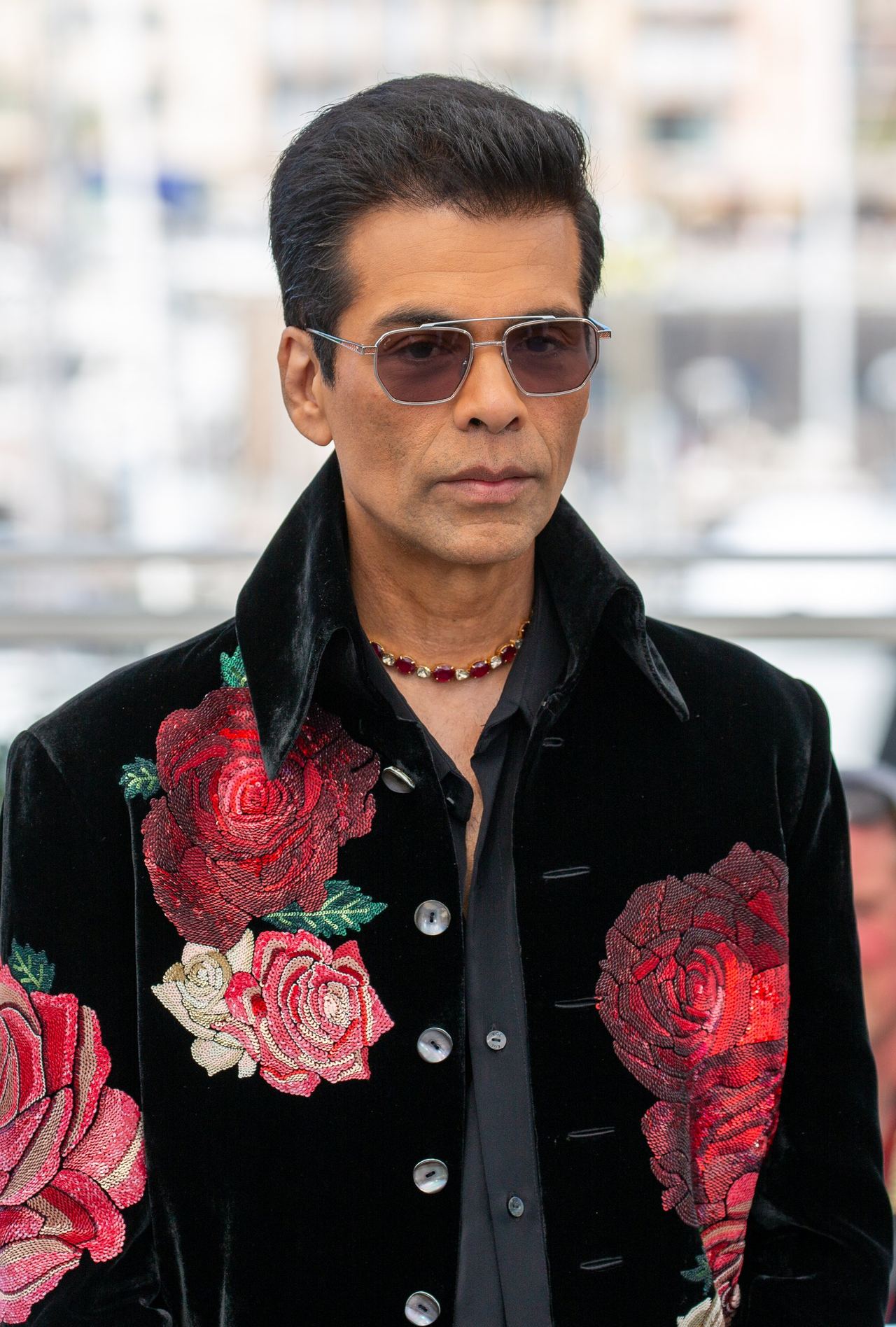
Photo Credit
Image courtesy of © Kacy Bao, CC BY-SA 4.0, via Wikimedia CommonsWaiting with Johar were Kareena Kapoor Khan and Saif Ali Khan, and the company’s chief executive, Apoorva Mehta. The visit lasted about 45 minutes and was partly private, so what we know comes from those in the room.
It was, in a sense, a meeting of two royal houses. One owes its crown to the box office. The other, as we will see, came with a genuine turban, a palace and a family tree that runs from an Afghan ally of the East India Company to a Bhopal begum.
A song from 2001, a promise for 2026
Dharma knew its audience. Dancers in traditional costume performed numbers from Kabhi Khushi Kabhie Gham, Johar’s 2001 family saga, including ‘Bole Chudiyan’, in which Kareena herself danced a quarter of a century ago, and ‘Shava Shava’. Invited to join in, the Prince declined with a royal ‘Maybe next time’, called it fantastic, and then turned the tables on his host: according to Hello!, he told Johar, ‘I won’t hold you back.’
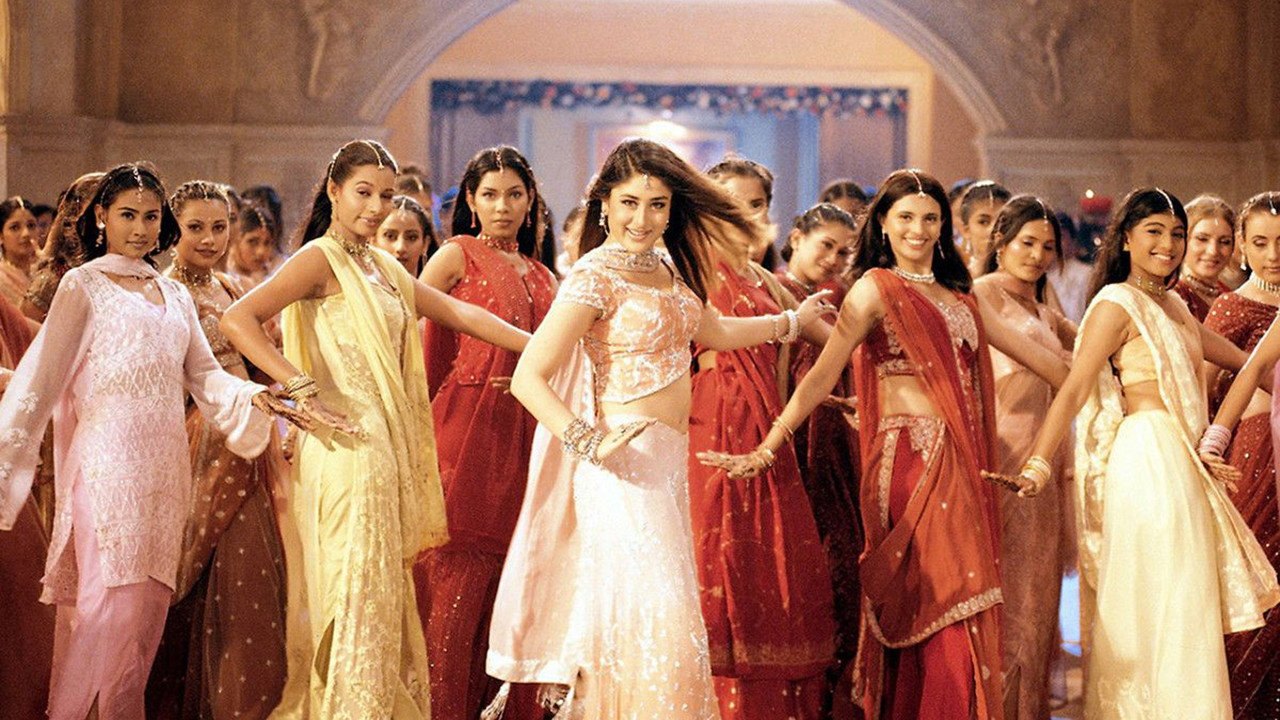
Photo Credit
Image courtesy of © Dharma ProductionsThe choice of film was not an accident. Kabhi Khushi Kabhie Gham, K3G to its fans, released on 14 December 2001 and spends its second half in Britain: St Paul’s Cathedral, the Thames, Blenheim Palace, the Bluewater shopping centre in Kent and the Millennium Stadium in Cardiff all appear, while Waddesdon Manor in Buckinghamshire stands in for the Raichand family’s London mansion.
Kareena played Poo, the most quoted schoolgirl in Hindi cinema. Johar said afterwards that the Prince, who is President of BAFTA, promised to watch it, just in time for its 25th birthday.
Lunch, according to The Indian Express, was Mumbai reimagined for a royal palate by the caterers The Big Zest: mini vada pav, Parsi kheema shakshuka, lobster and egg akuri on rusk, dhokla, fafda and jalebi, and a gulab jamun cheesecake to finish. Over it the talk was of cinema.
Johar said the Prince was ‘gracious and kind, and spoke extensively about the potential of Indian cinema’, and reported the theme of the hour: ‘we talked about Bollywood, but we’re so much more than Bollywood.’ The Press Trust of India said they discussed collaboration between British and Indian film-makers, which is BAFTA’s business as much as Dharma’s.
Even the group photograph needed a little choreography. Hello! noticed a brief shuffle over who stood where, until Kareena waved the Prince to her side. Fifty years of Dharma (Yash Johar founded the company in 1976, and its first production was Dostana in 1980) have taught everyone in the building how to frame a scene.
Meanwhile, across the city
The Princess of Wales spent the morning elsewhere, at the Nowrosjee Wadia Maternity Hospital in Parel, founded in 1926. Kensington Palace said she came to understand India’s approach to maternity care, and she met doctors, nurses, new mothers and their families: a quiet engagement that sits squarely inside her long-running work on the earliest years of life.
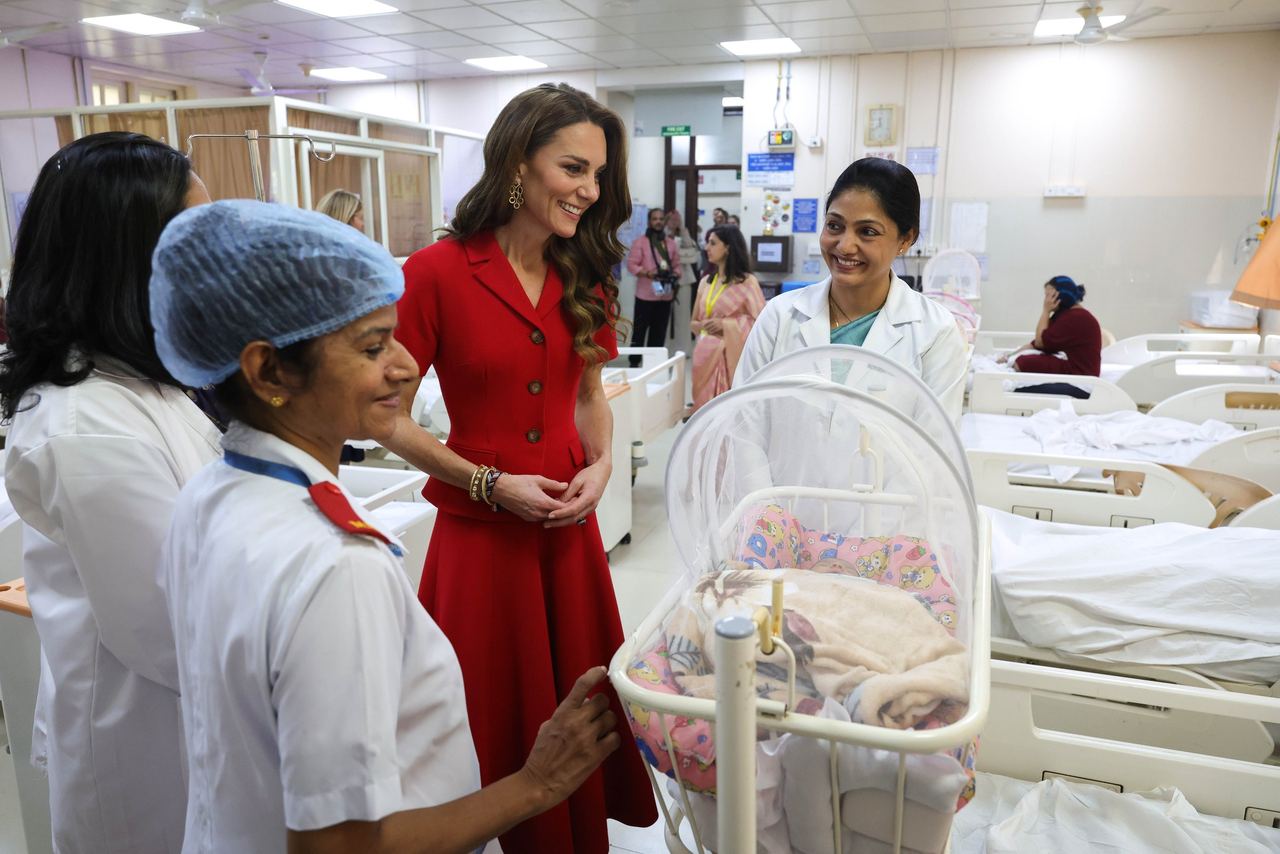
Photo Credit
Image courtesy of © Andrew Parsons / Kensington PalaceThe couple met again at the Chanakya School of Craft in Lower Parel, welcomed by its directors Karishma Swali and Nehal Shah. The school trains artisans in hand embroidery and traditional textile techniques, and the royal visitors tried their hand at wooden-block printing. Then it was the airport and an Air India flight to New Delhi for the final engagement of the tour.
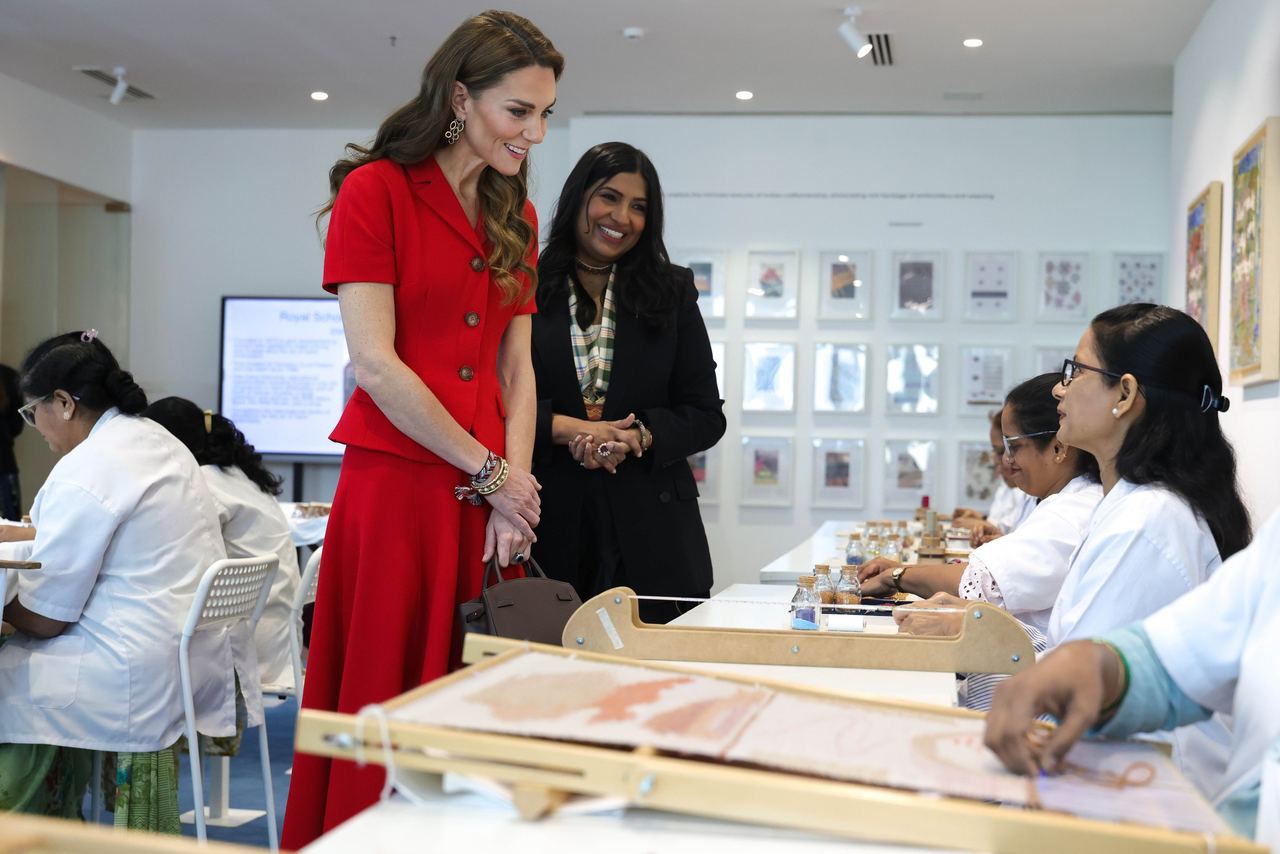
Photo Credit
Image courtesy of © Andrew Parsons / Kensington PalaceNot the first royal premiere
This was hardly the House of Windsor’s first brush with Indian film. In October 1997 Queen Elizabeth II was chief guest at the launch of an ambitious historical epic, Marudhanayagam, on a studio lot in Chennai, and spent 20 minutes on the set.
In April 2016 the Prince and Princess themselves arrived at the Taj Mahal Palace hotel for a Bollywood charity gala hosted by the British High Commission with the British Asian Trust, raising money for Magic Bus, Doorstep and Childline.
That night the Princess sat between Shah Rukh Khan and Adar Poonawalla of the Serum Institute of India, and the Prince beside Aishwarya Rai Bachchan; Madhuri Dixit, Sonam Kapoor and Sachin Tendulkar were in the room, and so was Karan Johar.
One house owes its crown to the box office. The other came with a turban, a palace and a Bhopal begum.
Ten years on, the guest list reads like a trailer for 2026. Tendulkar played gully cricket with the couple this time, Johar hosted the Earthshot Awards, the Serum Institute sponsored them, and Poonawalla has, since 2024, owned half of Dharma Productions.
The Nawab at the table
Bollywood calls its stars royalty as a matter of course. Saif Ali Khan is the rare case where the headline writers are technically correct. In October 2011, after the death of his father, elders in Pataudi village in Haryana tied a pagri on his head and declared him the tenth Nawab of Pataudi.
The title carries no power: the 26th Amendment to the Indian Constitution abolished the privy purses and the official recognition of rulers in 1971. It does carry a remarkable amount of history.
Pataudi began in 1804 with Faiz Talab Khan, an Afghan Pashtun whose family traced its roots to Kandahar, and who helped the East India Company in the Second Anglo-Maratha War. The Company rewarded him with land south-west of Delhi, and the little state of Pataudi was born. It lasted until 1948, when it became part of independent India.
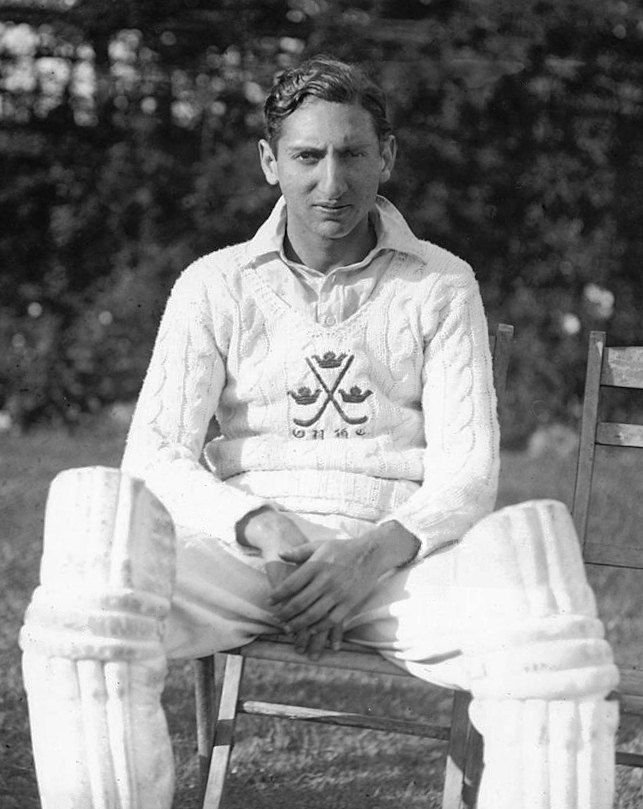
Photo Credit
Image courtesy of © Unknown photographer, public domain, via Wikimedia CommonsIts last ruler is one of cricket’s great curiosities. Iftikhar Ali Khan, the eighth Nawab, polished his game at Oxford and made his Test debut for England at Sydney in December 1932, in the Bodyline series, scoring a century. Fourteen years later he captained India on its 1946 tour of England, one of the very few men to have played Test cricket for both countries. He died on 5 January 1952, playing polo in Delhi, on his son’s eleventh birthday.
He also left a house. Pataudi Palace, completed in 1935 to designs by Robert Tor Russell with Karl Malte von Heinz, has 150 rooms on ten acres, and in 1939 Iftikhar married Sajida Sultan, a princess of Bhopal. After years as a heritage hotel the palace returned to the family in 2014, and Saif has since restored it as a private retreat where the family spends its winters.
The son was Mansoor Ali Khan, Tiger Pataudi, Nawab at eleven. In July 1961 a car crash in Hove left him with a damaged right eye; within a year, at 21 years and 77 days, he was captaining India, then the youngest Test captain in the world, a record he held until 2004.
In December 1968 he married Sharmila Tagore, the film star, whose maternal grandmother was a granddaughter of Rabindranath Tagore’s brother Dwijendranath. Their son grew up with a cricket bat on one side of the family and a Nobel laureate on the other.
The begums of Bhopal
Saif’s second royal line runs through his grandmother. Bhopal, in central India, was one of the most unusual princely states of the Raj: from 1819 to 1926 it was ruled by four women in succession, the begums, a century of women on the throne.
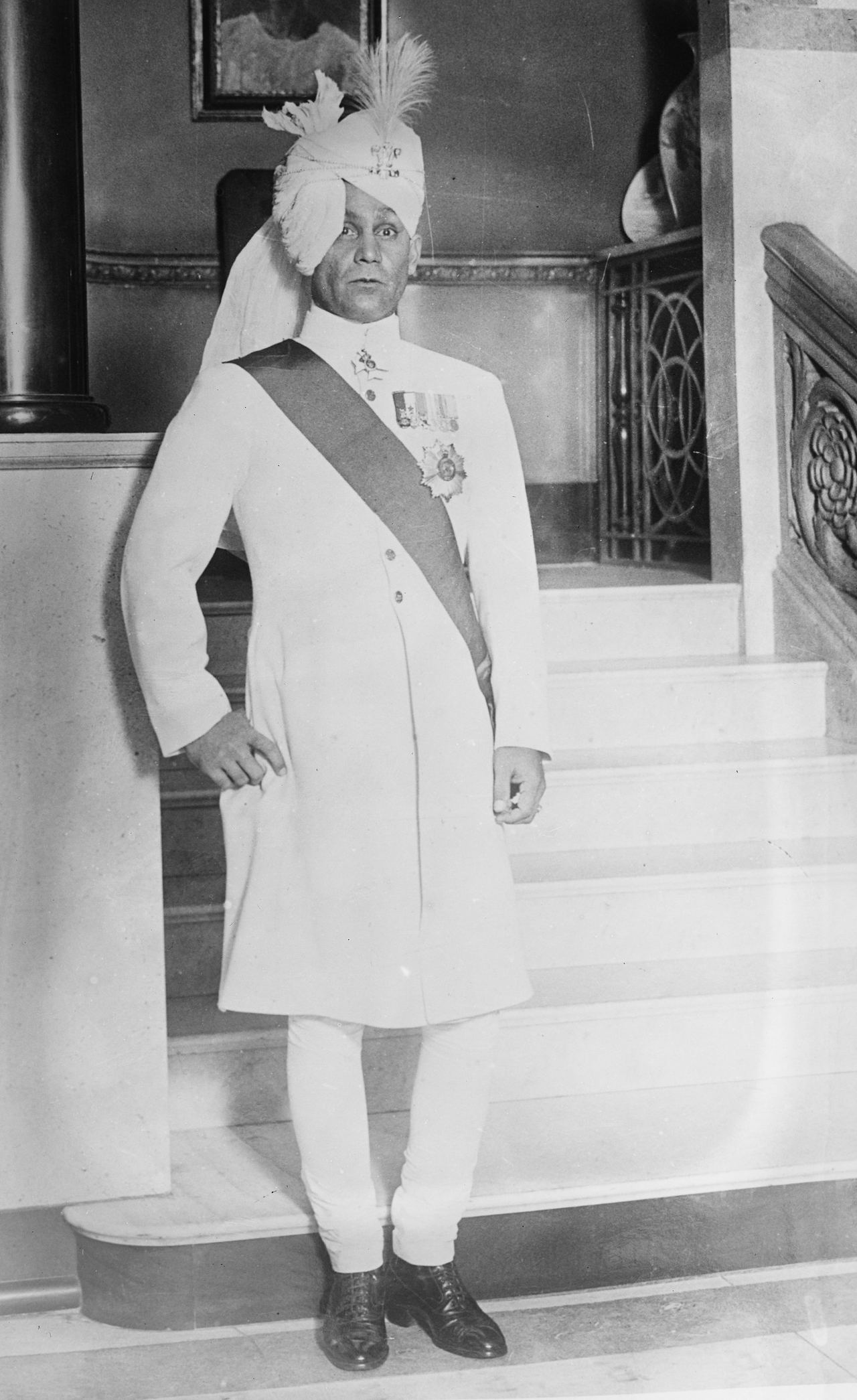
Photo Credit
Image courtesy of © Agence Rol, public domain, Bibliothèque nationale de France via Wikimedia CommonsThe last ruling Nawab, Hamidullah Khan, had no sons, and when he died in 1960 his eldest daughter, Abida Sultan, had already moved to Pakistan, in 1950. The Government of India recognised her younger sister, Sajida Sultan, Saif’s grandmother, as the Nawab Begum instead.
Partition, in other words, runs straight through the family. Abida Sultan’s son, Shahryar Khan, became Pakistan’s foreign secretary and twice chaired the Pakistan Cricket Board before his death in 2024; on the other side of the border his first cousin, Tiger, captained India. It is hard to think of a family that better explains why India and Pakistan treat cricket as something close to diplomacy.
Courtrooms rather than ceremonies
Inheritance is the less glamorous half of the story. The family’s Bhopal estate, reported to be worth around ₹15,000 crore, has been caught up for years in proceedings under India’s Enemy Property Act, the law that governs property linked to those who moved to Pakistan; Abida Sultan’s emigration is the reason.
In mid-2025 the Madhya Pradesh High Court overturned a 1999 judgment that had recognised Sajida Sultan’s right to the properties. For a family used to ceremonies, it has become a story of lawyers.
Which leaves a question worth asking as the cameras roll on: what is a title worth when the law no longer recognises it? At Pataudi the answer seems to be continuity, a restored palace and a pagri brought out for ceremonies.
In Bhopal, it is a file in a courthouse. And in Andheri on a November morning, it was simply this: a Nawab, a Prince and a producer sharing vada pav and talking about the next film. Mumbai has always been good at turning history into a good scene.
Why it's on our list
- Bole Chudiyan for a prince
- Vada pav and a promise to watch K3G
- The Princess at Wadia and Chanakya
- From the 2016 Taj gala to 2026
- Pataudi: the Nawab who played for England and India
- Bhopal’s four begums, and a court case
Location
The map comes from Google Maps, which sets its own cookies once it loads.
More in depth
 The back storyBollywood and Yash Raj Films: from Phalke to Yash Chopra’s love storiesFrom the first feature to Yash Chopra’s great love stories.
 The back storyMumbai Art, Architecture & Culture: from Kala Ghoda to the NMACCKala Ghoda, the Oval Maidan, the NCPA and the NMACC.
 The back storyCinema in Mumbai: Art Deco picture palaces and a love story since 1995Art Deco picture palaces and a film running since 1995.